Funding Opportunities
This page is designed as a resource for researchers from Bavaria and Czechia. Here you can find the different funding agencies pages where calls will be published, as well as individual calls for projects.
Seed Funding Program 5G Corridor Munich - Prague
SEED FUNDING PROGRAM 5G CORRIDOR MUNICH - PRAGUE │ BAVARIAN STATE CHANCELLERY
|
Seed funding program 5G Corridor Munich - Prague │ Bavarian State Chancellery
The program is aimed at advanced scientists (postdoc and above) working at a Bavarian state university or state university of applied sciences as defined by the Bavarian State Ministry of Science and the Arts. The seed funding program should be used for networking purposes, as well as promote the establishment of bilateral research projects in the 5G Corridor Munich - Prague. The seed funding grants are intended as a first stage for project set-up and are to be supplemented with other funding instruments during the course of the project. The seed funding amounts to a maximum of EUR 7,500 (lump sum) and supports project-related travel and accommodation costs of scientists from Bavaria and the Czech Republic who want to establish a cooperation project in the areas of the 5G Corridor Munich - Prague. The seed funding can also support a single project-specific two- to three-month short-term research stay of PhD students in the partner institution per funding measure. On behalf of the Bavarian State Chancellery, the 5G Corridor Munich - Prague in the WKS Bavaria-Québec/Alberta/International, Bavarian Research Alliance (BayFOR), manages this program. As a first step, a personal meeting to discuss the respective objectives and modalities before each submission needs to be arranged. Project ideas are accepted on an ongoing basis. For more information, please contact: In Munich: |
Multilateral Funding
HORIZON EUROPE │ EUROPEAN UNION
|
Horizon Europe │ European Union
In 2018, the European Commission proposed an ambitious €95.5 billion research and innovation programme - Horizon Europe - to succeed Horizon 2020. Horizon Europe is the research and innovation framework programme running from 2021-2027. The programme supports European partnerships with EU countries, the private sector, foundations, and other stakeholders. The aim is to deliver on global challenges and industrial modernisation through concerted research and innovation efforts. For individual calls visit the EU Funding & Tenders Portal. In Germany, the BMBF is funding measures for the preparation and drafting of proposals for calls in the second pillar of Horizon Europe (Global Challenges and European Industrial Competitiveness). The programme is called European Innovation Union and supports applicants with a maximum of €50.000 over a period of up to 12 months. The annual deadlines are January 31, Mai 31, and September 30. |
EUROPEAN COOPERATION IN SCIENCE AND TECHNOLOGY (COST) │ EUROPEAN UNION
|
European Cooperation in Science and Technology (COST) │ European Union
Deadline: October 23, 2024 (the next deadline will be in autumn 2025) Value: dependent upon proposal The European Cooperation in Science and Technology (COST) is a funding organization for the creation of research networks, called COST Actions. These networks offer an open space for collaboration among scientists across Europe (and beyond) and thereby give impetus to research advancements and innovation. COST is bottom up, this means that researchers can create a network – based on their own research interests and ideas – by submitting a proposal to the COST Open Call. The proposal can be in any science field. COST Actions are highly interdisciplinary and open. It is possible to join ongoing Actions, which therefore keep expanding over the funding period of four years. They are multi-stakeholder, often involving the private sector, policymakers, as well as civil society. COST funding intends to complement national research funds, as they are exclusively dedicated to cover collaboration activities, such as workshops, conferences, working group meetings, training schools, short-term scientific missions, and dissemination and communication activities. COST Program Website |
DANUBE TRANSNATIONAL PROGRAMME │ INTERREG (CLOSED)
|
Danube Transnational Programme │ Interreg
Deadline: April 3, 2024 (one step call for proposals) Value: dependent on the project proposal, maximum co-financing of 80% The Danube Transnational Programme (DTP) promotes economic, social, and territorial cohesion in the Danube Region through policy integration in selected fields. In order to achieve a higher degree of territorial integration of the very heterogeneous Danube region, the transnational cooperation programme acts as a policy driver and pioneer to tackle common challenges and needs in specific policy fields where transnational cooperation is expected to deliver tangible results. Projects submitted under the second call should focus on one of the following programme specific objectives:
Danube Transnational Programme Website The Bavarian Ministry of Economic Affairs, Regional Development and Energy (StMWi) supports Bavarian stakeholders in the preparation of proposals for the Danube Transnational Programme. The Start Transnational Programme funds applicants with a maximum of €30.000, the funding rate is between 60% and 90%. Applications can be submitted continuously, at the latest 8 weeks before the deadline of the Interreg call. |
CENTRAL EUROPE │ INTERREG (CLOSED)

|
CENTRAL EUROPE │ Interreg
Deadline: the launch of the third call is expected in October 2024, focusing on small-scale projects Value: dependent on the project proposal, maximum co-financing of 80% Interreg Central Europe envisions a united central Europe that cooperates - to become smarter, greener and better connected together. The programme mission is to bring regions and cities together beyond borders to find fitting solutions for their citizens. It encourages and supports transnational cooperation to make regions more resilient to common challenges that know no borders and which cannot be solved alone. These challenges include among others economic transition processes, climate change, and the long-term socioeconomic consequences of the Covid-19 pandemic. Thematic priorities:
Interreg Central Europe Call Website The Bavarian Ministry of Economic Affairs, Regional Development and Energy (StMWi) supports Bavarian stakeholders in the preparation of proposals for the Central Europe Programme. The Start Transnational Programme funds applicants with a maximum of €30.000, the funding rate is between 60% and 90%. Applications can be submitted continuously, at the latest 8 weeks before the deadline of the Interreg call. |
SCIENCE FOR PEACE AND SECURITY (SPS) PROGRAMME: MULTI-YEAR PROJECTS │ NATO
|
Science for Peace and Security Programme: Multi-Year Projects │ NATO Deadline: June 30th, 2024 for the call for proposals 2024-2 Value: no hard limits; typically 150,000 – 350,000 € for a three-year project The NATO Science for Peace and Security Programme (SPS) seeks to enhance cooperation and dialogue between NATO and its partner nations through civil science and innovation. The SPS Programme funds security-related activities relevant to NATO‘s strategic objectives which address SPS Key Priorities, for example security challenges including cyber defence and Innovation and Emerging Disruptive Technologies. Proposals for Multi-Year Projects should research and develop innovative solutions and demonstrators. They should also demonstrate a solid and long-term approach, indicating clearly the expected maturity (Technology Readiness Level) to be reached, and how additional actors (e.g. industrial partners, programmes, national funding, end users, etc.) will be involved in further developing and exploiting the results of the SPS-supported activity after its conclusion. Projects have to be developed jointly by scientists or experts from at least one NATO (e.g. the Czech Republic or Germany) and one eligible partner nation (e.g. Austria). NATO has also another call for proposal for events in the following format: advanced research workshops, advanced training courses, and advanced study institutes. Find the call for proposals here. NATO Science for Peace and Security Programme Website |
Bilateral Funding
EUREKA │ DFG AND MŠMT
|
Eureka │ DFG and MŠMT
Deadline: dependent on the programme Value: dependent on the programme Eureka programmes are funded by the Federal Ministry of Education and Research on the German side and by the Ministry of Education, Youth and Sports on the Czech side. Eureka is an international network established as an agreement between 18 countries to foster European competitiveness and integration and to encourage R&D cooperation. Eureka is a research initiative, not a funding programme. Project funding does not come from a central budget but it is regulated individually in each member country. Project participation can be funded by national funding programs, by own funds, or other possibilities. To support international industry-led R&D projects, Eureka offers a variety of programmes. The following programmes offer funding opportunities for researchers in the 5G Corridor Munich - Prague:
Eureka Programme Website |
INDIVIDUAL RESEARCH GRANTS PROGRAMME │ DFG AND GAČR

|
|
Individual Research Grants Programme │ DFG and GAČR
Deadline: The DFG as lead agency accepts proposals at any time of the year. GAČR has one submission deadline for lead-agency proposals per year. Value: the programme funds a variety of activities Research grants enable individuals who have completed their academic training to conduct at any time research projects with clearly defined topics and duration, regardless of the subject. A research project must be of high scientific quality and originality, carried out at an international level. The duration of funding is based on the individual project needs (usually several years). Since the beginning of 2021, the Weave Lead Agency Procedure aims to simplify the submission and selection procedures for closely integrated collaborative research proposals involving researchers from up to three European countries or regions. It does this by making proposals go through a single evaluation procedure. Programme Website DFG Programme Website GAČR |
BAVARIAN-CZECH ACADEMIC PROJECTS 2024│ BTHA
|
Bavarian-Czech Academic Projects 2024 │ BTHA
Deadline: acceptance of proposals every time of the year. Projects should be carried out and billed until the beginning of December 2024. Value: max. €5.000 The programme supports academic projects of Bavarian universities in cooperation with partners in the Czech Republic. The aim of this program is to pave the way for continued cooperation in research and teaching, both in terms of content and with regard to later acquisition of third-party funding, for example for applications to EU research funding programs. Support is provided, for example, for Bavarian-Czech conferences, scientific workshops, seminars, excursions, project discussions, project preparation, etc. Projects involving young scientists (master students, doctoral students) are particularly welcome. Programme Website BTHA |
DIOSCURI PROGRAMME │ BMBF AND MEYS (CLOSED)

|
Dioscuri Programme │ BMBF and MEYS
Deadline: July 25, 2022; more calls are planned for the upcoming years Value: each Centre is funded with up to € 300,000 per year for an initial five years; an extension for another five years is possible The Dioscuri Programme was initiated by the Max Planck Society to support scientific excellence in Central and Eastern Europe. It aims to establish internationally competitive research groups at Central and Eastern European scientific institutions with the support of partners from Germany. The person-centered programme is funded by the German Federal government as well as the government of the respective host country. The programme seeks to support outstanding scientists who would like to establish and lead a highly visible research group. Dioscuri Centres are established at research institutions that are capable of providing adequate infrastructure and that offer an environment for cutting-edge research. A total of up to five Dioscuri Centres are to be established in the Czech Republic in the coming years. They will be funded in equal parts by the German Federal Ministry of Education and Research (BMBF) and the Czech Ministry of Education, Sports and Youth (MEYS) with a total of 300,000 euros per year. Two cross-disciplinary rounds of calls are planned. The calls are open to early-career researchers from all scientific disciplines and regardless of their country of origin or current employment. Programme Website Dioscuri Centres |
JOINT CALL BAVARIA - CZECHIA 2024-2026 │ BTHA (CLOSED)
|
Joint Call Bavaria - Czechia 2024-2026 │ BTHA
Deadline: November 30, 2023 Value: max. 480.000 € over 2.5 years for a bilateral project The aim of the funding program is to promote scientific cooperation between the Czech Republic and the Free State of Bavaria, to support cross-border cooperation between young researchers from Bavaria and the Czech Republic, and at the same time to encourage scientists from both countries to submit joint applications for bilateral projects. Projects that aim at further internationalization of research and lead to a joint application in funding programs on federal or EU level (Horizon Europe, Interreg, DFG - GA ČR and others) are especially welcomed. The funding program is open to basic and applied research projects in the following subject areas:
On the Bavarian side, topics of the High-Tech Agenda Bavaria are preferred. Applications for the joint Bavarian-Czech project are submitted in parallel in Bavaria and the Czech Republic, with one application from the Bavarian university and one from the Czech university or research institution. Funding is available for projects implemented during the period 1.7.2024 – 31.12.2026. BTHA Call Website |
INTERREG BAVARIA - CZECH REPUBLIC 2021-2027 │ INTERREG

|
Interreg Bavaria - Czech Republic │ Interreg
Deadline: August 27, 2024 for project application in the 5th Monitoring Committee Value: dependent on the project proposal, maximum co-financing of 80%. Projects can be submitted in the following calls: Projects with total costs over €200,000, Projects with total costs up to €200,000, and Small Project Fund Managers. The INTERREG Bavaria - Czech Republic 2021-2027 program is part of the European Cohesion Policy within the framework of the objective "European Territorial Cooperation". It supports the cross-border cooperation between Bavaria and the Czech Republic. The aim is to overcome challenges together and to create a common living, natural and economic area. From the European Regional Development Fund (ERDF), EU funding amounting to overall 99 million euros will be made available to the program for the implementation of cross-border projects. Programme priorities:
Programme Website Interreg Bavaria - Czech Republic (DE & CZ) Programme area: 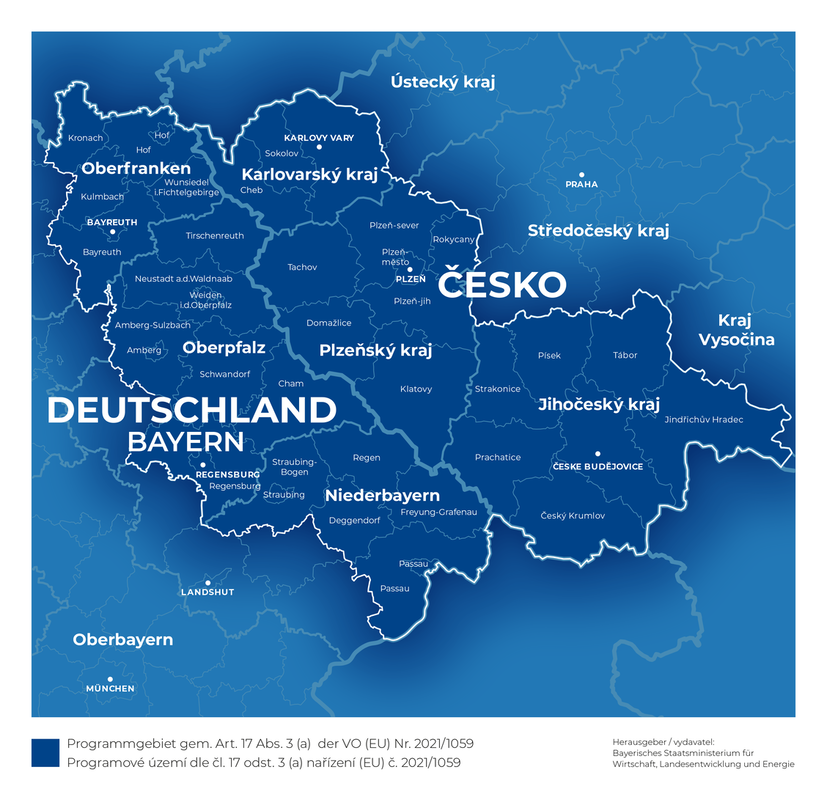
|
Unilateral Funding - Germany and Bavaria
FH-EUROPA │ BMBF
|
FH-Europa │ BMBF
Deadline: acceptance of proposals every time of the year until June 30, 2027 Value: max. €75.000 With the measure "FH-Europa", the German Federal Ministry of Education and Research aims to increase the participation of Universities of Applied Sciences (UAS) in EU programs such as "Horizon Europe", "Green Deal", or "EUREKA". The purpose is to enable UAS to expand and strengthen their networks at the European level and to establish themselves sustainably and in the longer term with their research foci in the scientific community. Through FH-Europa, professors from UAS are to be encouraged to network at the European level, to concretize topic-specific project proposals for "Horizon Europe" and other EU programs together with research partners, to successfully submit corresponding applications, and to establish research foci at the European level. In addition to the targeted preparation and submission of concrete project proposals to the EU, this measure is also intended to support network-building measures that ideally lead to several applications being submitted and/or to the formation and strengthening of (researcher) networks at the European level during the project term. The maximum duration for projects is 12 months. FH-Europa Programme Website |
FH-KOOPERATIV │ BMBF (CLOSED)
|
|
FH-Kooperativ │ BMBF
Deadline: for first-time appointees: July 15, 2023 Value: The basis for assessment is the total eligible project-related expenditure FH-Kooperativ (Research at Universities of Applied Sciences in Cooperation with Companies) supports universities of applied sciences (UAS) in their cooperation with partners from the commercial and scientific communities. Thus, knowledge and technology transfer between universities and companies is to be strengthened in order to enable the collaboration partners to develop innovative solutions for the business world. FH-Kooperativ will only fund projects that are embedded in the research profile or in a research focus of the respective UAS. Research projects should be of an interdisciplinary nature. FH-Kooperativ provides funding for projects in the fields of application-oriented engineering, health, as well as economic and social sciences that are characterized by a highly application-oriented approach, significant economic potential, and a scientific and technical challenge that extends beyond the state of the art. The project duration should be 36 months. Deviations are possible. FH-Kooperativ Programme Website (DE) |
INTERNATIONAL COOPERATION IN EDUCATION, SCIENCE, AND RESEARCH │ BMBF
|
|
International Cooperation in Education, Science, and Research │ BMBF
Deadline: dependent upon proposal Value: dependent upon proposal The German Federal Ministry of Education and Research (BMBF) supports the networking of research and education with partners around the world. Funding is provided for the expansion of international contacts and networks. Synergies between the various activities of the participating actors from science, industry, and politics are used to achieve the greatest possible impact. The project must take into account country-specific priorities and must be related to the Ministry’s framework programmes and European funding programmes. Funding is provided within the framework of separate calls for proposals. |
COMMUNICATION SYSTEMS AND IT-SECURITY│ BMBF
|
|
Communication Systems and IT-Security│ BMBF
Deadline: dependent upon funding call Value: dependent upon fudning call The German Federal Ministry of Education and Research (BMBF) funds individual and collaborative projects from a broad range of topics in the frame of communication systems and IT-Security. The thematic funding priorities are published on an ad hoc basis and in separate funding calls. Communication Systems and IT-Security Calls Website (DE) |
DIGITALIZATION FUNDING LINE │ STMWI
|
Digitalization Funding Line │ StMWi
Deadline: dependent upon proposal Value: dependent on the individual call for proposal (for a commercial enterprise, the grant amounts to a maximum of 50% of eligible expenses in the case of industrial research and 25% in the case of experimental development. Universities, non-university research institutions, or equivalent organizational units may receive higher funding rates under certain conditions.) The Bavarian Ministry of Economic Affairs, Regional Development and Energy (StMWi) supports research and development projects of companies and research institutions cooperating with companies in the field of digitization as part of the Bavarian Collaborative Research Program (BayVFP). Funding for an industry-led collaborative project focuses on the following areas:
Thematic priorities and funding objects as well as evaluation criteria are defined in the context of special funding calls. Digitalization Funding Line Programme Website (DE) |
LIFE SCIENCE FUNDING LINE - MEDICAL TECHNOLOGY │ STMWI (CLOSED)
|
|
Life Science Funding Line - Medical technology │ StMWi
Deadline: January 31, 2024; next call is planned for autumn 2024 Value: dependent on the individual call for proposal (for a commercial enterprise, the grant amounts to a maximum of 50% of eligible expenses in the case of industrial research and 25% in the case of experimental development. Universities, non-university research institutions, or equivalent organizational units may receive higher funding rates under certain conditions.) The Bavarian Ministry of Economic Affairs, Regional Development and Energy (StMWi) supports research and development projects of companies and research institutions cooperating with companies in the field of life sciences within the framework of the Bavarian Collaborative Research Program (BayVFP). Funding is available for industry-led collaborative projects that focus on innovative developments in the field of medical technology, i.e. collaborative projects for researching and developing new or improved products and/or processes. The funding is intended to enable research and development (R&D) work in the field of life science - medical technology and to accelerate the implementation of research results in new products and/or processes. The collaborations should have the potential to bring what has been researched to market. Thematic priorities and funding objects as well as evaluation criteria are defined in the context of special funding calls. Life Science Fundling Line - Medical Technology Programme Website (DE) |
HIGH TECHNOLOGIES FOR THE 21ST CENTURY │ BAVARIAN RESEARCH FOUNDATION
|
High Technologies for the 21st Century │ Bavarian Research Foundation
Deadline: acceptance of proposals every time of the year Value: dependent on the type of research (up to a maximum of 50% of the eligible costs in the case of industrial research and up to a maximum of 25% of the eligible costs in the case of experimental development) The Bavarian Research Foundation supports innovative research and development projects in which companies work together with commercial enterprises, especially small and medium-sized enterprises, universities or non-university research institutions to develop new technologies, processes, products and services. Funding for collaborative projects in basic research, industrial research and experimental development in the following areas:
Support for international partners: Funding is provided for foreign scientists in Bavaria and Bavarian scientists from universities, colleges, and research institutions abroad. High Technologies for the 21st Century Programme Website (DE) |
BAYINTAN │ BAVARIAN RESEARCH ALLIANCE (CLOSED)

|
BayIntAn │ Bavarian Research Alliance
Deadline: expected upcoming deadline in November 2024 Value: max. €10.000 The Bavarian Funding Programme for the Initiation of International Projects (BayIntAn) provides assistance for establishing and strengthening the scientific cooperation between scientists at Bavarian state and state-supported non-state universities and international research institutes. The prerequisite for being funded is that the planned cooperation must include at least one international partner. The evaluation criteria include sustainability, development opportunities of the planned projects, the possible initiation of specific projects as part of the international research cooperation, as well as the suitability and need to receive the requested funding. The following expenditures for Bavarian scientists can be subsidized:
BayIntAn Programme Website |
INTEGRATION OF THE CENTRAL EASTERN AND SOUTH EASTERN EUROPEAN REGION INTO THE EUROPEAN RESEARCH AREA (BRIDGE2ERA2021) │ BMBF
|
|
Integration of the Central Eastern and South Eastern European Region into the European Research Area (Bridge2ERA2021) │ BMBF
Deadline: the application procedure has two stages; for the first stage, project outlines can be handed in until 31 May 2024. In the second stage of the procedure, the positively evaluated project outlines are invited to submit a formal funding application Value: usually 120.000€ for a project duration of up to 24 months The object of the funding is the joint application preparation of multilateral research and innovation projects that are aligned with the thematic areas of the EU Framework Program for Research and Innovation Horizon Europe as well as with other relevant European funding programs, for example Interreg and Eurostars. In particular, new networks with the target countries of the announcement are to be established and maintained over the period of the entire funding. The goal is to establish networks that will continue beyond the project period. Target countries for this announcement are:
The preparation of applications for research and development projects is carried out in two phases:
Bridge2ERA Call Website (DE) |
START-INTERACTIVE: INTERACTIVE TECHNOLOGIES FOR HEALTH AND QUALITY OF LIFE │ BMBF
|
|
START-Interactive: Interactive Technologies for Health and Quality of Life │ BMBF
Deadline: the application process is two stage, deadlines for submission of project outlines for modules 1 and 2 are January 15 and July 15 each year Value: dependent on the eligible project-related costs, funding period from 18 months to 3 years The BMBF wants to strengthen the innovation potential of start-ups in cutting-edge research on interactive technologies for health and quality of life. Funding will be provided for spin-offs focusing on the two thematic areas of the "Together through Innovation" research program:
Module 1: Support for Start-up Teams at Universities and Research Institutions In Module 1, funding is provided for innovations in interactive technologies for health and quality of life at universities or research institutions in the form of individual projects. Project ideas from already existing research groups with a high R&D content are funded in order to increase the maturity of the research content achieved and its potential for exploitation. This also includes funded but already completed projects in the field of interactive technologies, which aim to commercially exploit the R&D results through a spin-off. Eligible to apply for Module 1 are universities and research institutions at which the research groups are located. Module 2: Support for Young Start-ups in Research and Development Module 2 supports young start-ups that have already been founded in research and development. The object of the funding is high-risk research and pre-competitive development projects that are cross-technology and application-oriented and have a direct positive impact on the innovative ability and expected competitive opportunities of the start-ups involved. Eligible to apply for module 2 are start-ups, SMEs, medium-sized companies, universities, and research institutions. The following projects are eligible for funding:
START-Interactive Programme Website (DE) |
CYBER SECURITY AND DIGITAL SOVEREIGNTY IN COMMUNICATION TECHNOLOGIES 5G/6G │ BSI (CLOSED)

|
Cyber security and digital sovereignty in communication technologies 5G/6G │ BSI
Deadline: December 2, 2022 for the project outline. After a review process, the project partners of the most promising outlines in the second stage will then be invited to submit formal full proposals by March 1st, 2022. Value: dependent on project focus The Federal Office for Information Security (BSI) funds research and development projects in the field of digital sovereignty and cyber security for 5G/6G communication technology. The funding programme strengthens the innovative power of companies, promotes Germany's digital sovereignty and contributes to Germany's leading role as a technology provider in 5G and 6G at the global level. The funding programme is based on the following 5 thematic priorities:
A total of up to €60 million is available for funding, subject to the budget situation. The programme is aimed at commercial enterprises (e.g. network operators, campus network operators, manufacturing companies, integrators, consulting and training companies), municipalities, higher education institutions and non-university educational and research institutions. Thematic priority 5 focuses on the promotion of young companies and small and medium-sized enterprises (SMEs). Programme Website |
Unilateral Funding - Czechia
TREND PROGRAMME │ MINISTRY OF INDUSTRY AND TRADE / TECHNOLOGY AGENCY OF THE CZECH REPUBLIC (CLOSED)
|
TREND Programme │ Ministry of Industry and Trade of the Czech Republic / Technology Agency of the Czech Republic
Deadline: November 23, 2022 Value: max. €615.000 and funding rate of max. 70% Preliminary Parameters The eighth public competition of the TREND programme is aimed at supporting projects dealing with the development of 5G and higher technologies. Projects must be led by a Czech enterprise; research organisations can participate as additional partners. The project length must be between 12 and 31 months . This TREND programme can also fund international partners. TREND Program Announcement (CZ) For more information in German/English on the TREND programme, please contact the Munich - Prague team. Tenders will be announced annually in the period 2020 to 2023. TREND Programme Website (CZ) |
SIGMA PROGRAMME │ TECHNOLOGY AGENCY OF THE CZECH REPUBLIC
|
SIGMA Programme│ Technology Agency of the Czech Republic
Deadline: dependent upon call for proposals; next deadline 17 July, 2024, for bilateral projects with Saxony, Federal Republic of Germany Value: dependent upon call for proposals The SIGMA program is a new comprehensive tool, which is aimed at fulfilling and solving a number of goals and measures set by key strategic and conceptual documents for the field of research, development and innovation in the Czech Republic. The main vision of the newly intended broad support tool is the consolidation of several current TA CR programs into one program, enabling support for regions according to their innovation potential, support for cross-cutting and systemic measures, including leaving room for support in areas/topics not identified at the time of program preparation. The main goal of the program is to support applied research and innovation leading to the creation of new results that can be applied in practice, to address the challenges and needs of society and the economy, and to support the solution of systemic measures of the research and innovation environment. Fulfillment of the main objective of the program will take place through five sub-objectives. Sub-goal 1 – Activities of so-called pre-application research (DC1) Goal definition: Streamline the transfer of knowledge and results of research and development from research organizations to practice and speed up the creation of new innovative products and services. Sub-goal 2 – Beginning researchers and equalizing opportunities in applied research projects (DC2) Goal definition: Increase the involvement of beginning researchers and equalize opportunities for women and men in applied research competition. Sub-goal 3 – Supporting the innovation potential of social sciences, humanities and arts (DC3) Goal definition: Increase the innovation potential and effectiveness of research in social sciences, humanities and arts. Sub-goal 4 – International cooperation (DC4) Goal definition: To increase the number of applied research results generated as part of international cooperation projects and to expand the number of cooperation between domestic and foreign companies and research organizations. Sub-goal 5 – Cross-cutting support (DC5) Goal definition: Strengthen support for new opportunities in applied research and innovation projects. The duration of the program is set for the period from 2022 to 2029, i.e. 8 years. Several public competitions will be announced every year. SIGMA Programme Website (CZ) |
Unilateral Funding for SMEs and Partners - Germany and Bavaria
SME-INNOVATIVE: ELECTRONICS AND AUTONOMOUS DRIVING; HIGH PERFORMANCE COMPUTING│ BMBF
|
|
SME-Innovative: Electronics and Autonomous Driving; High Performance Computing │ BMBF
Deadline: project outlines can be submitted at any time. Evaluation deadlines for project outlines are April 15 and October 15 of each calendar year. Value: up to 60% of the eligible costs for companies in the commercial sector and up to 100% of eligible costs for universities and non-university research institutions The German Federal Ministry of Education and Research (BMBF) supports high-risk, application-oriented projects in industrial research and experimental development in the fields of electronics and autonomous driving. The project focuses on innovative electronics systems or hardware-based innovations for autonomous driving. The project must be relevant for the future positioning of participating small and medium-sized enterprises SMEs in the market. Funding of:
Possible fields of application:
The possible funding period is usually three years. SME-Innovative Electronics and Autonomous Driving; High Performance Computing Programme Website (DE) |
SME-INNOVATIVE: INFORMATION AND COMMUNICATION TECHNOLOGY (ICT) │ BMBF
|
|
SME-Innovative: Information and Communication Technology (ICT) │ BMBF
Deadline: : project outlines can be submitted at any time. Evaluation deadlines for project outlines are April 15 and October 15 of each calendar year. Value: up to 60% of the eligible costs for companies in the commercial sector and up to 100% of eligible costs for universities and non-university research institutions The German Federal Ministry of Education and Research (BMBF) supports small or medium-sized enterprises in individual and joint projects in the areas of Data science, information technologies, Industry 4.0 as well as Communication systems and IT security. Funding of:
The project must be focused on the application fields/industries:
The possible funding period is usually three years. SME-Innovative Information and Communication Technology (ICT) Programme Website (DE) |
SME-INNOVATIVE: MEDICAL TECHNOLOGY │ BMBF
|
|
SME-Innovative: Medical Technology │ BMBF
Deadline: project proposals can be submitted at any time of the year. Evaluation deadlines for project outlines are April 15 and October 15 of each calendar year. Value: up to 50% of the eligible costs for companies and up to 100% of eligible costs for universities and non-university research institutions Funding is available for high-risk industrial research and development projects with a strong connection to healthcare and applications in the form of individual company projects (individual projects) or cooperation projects between companies, research institutions and clinical partners (joint projects) for the development of new products and processes for healthcare. These research and development projects must be assigned to medical technology and be of importance for the company's positioning on the market. The main objective of BMBF funding is to strengthen the position of SMEs by accelerating the transfer of knowledge and technology from the field to the practical day-to-day care of the healthcare industry. The possible funding period is up to three years. SME-Innovative: Medical Technology Programme Website (DE) |
SME-INNOVATIVE: INTERACTIVE TECHNOLOGIES FOR HEALTH AND QUALITY OF LIFE │ BMBF
|
|
SME-Innovative: Interactive Technologies for Health and Quality of Life │ BMBF
Deadline: project outlines can be submitted at any time. Evaluation deadlines for project outlines are April 15 and October 15 of each calendar year. Value: dependent on the type of research (for companies: up to a maximum of 50% of the eligible costs in the case of industrial research and up to a maximum of 25% of the eligible costs in the case of experimental development); up to 100% of eligible costs for universities and non-university research institutions Funding is provided for high-risk industrial research and pre-competitive development projects that are cross-technology and application-oriented. Funding is provided for projects dealing with
Eligible for funding are individual projects of an SME as well as collaborative projects between one or more SMEs, universities, research institutions and other SMEs. At least one SME must be involved in the project. The project should be initiated and coordinated by an SME or medium-sized enterprise. Programme Website (DE) |
Mobility Funding
MOBILITY FUNDING BAVARIA/CZECHIA 2023 │ BTHA
|
Mobility Funding Bavaria/Czechia 2023 │ BTHA
Deadline: proposals can be submitted at any time Value: max. €1.000 Students, teachers and researchers from Bavaria and the Czech Republic can apply for mobility grants for research stays in the Czech Republic or in Bavaria in cooperation with their academic supervisors or teachers from Bavarian universities. The applicant is the researcher or teacher at a Bavarian university (in any case). In case of approval, the grant will be assigned to a cost center of the applying Bavarian university. BTHA Mobility Funding Programme Website (DE/CZ) |
Tools
PARTNERING TOOL │ TECHNOLOGY AGENCY OF THE CZECH REPUBLIC
|
|
Partnering Tool │ Technology Agency of the Czech Republic
The Technology Agency of the Czech Republic helps Czech enterprises and research organizations to establish cooperation in the area of applied research and innovations through a partnering tool. Institutions, enterprises, and researchers looking for partners can either post a partner request or a partner offer. Partnering Tool (EN) |
TA ČR STARFOS │ TECHNOLOGY AGENCY OF THE CZECH REPUBLIC
|
|
TA ČR Starfos │ Technology Agency of the Czech Republic
TA ČR Starfos is a search engine for projects and results in the field of research, experimental development, and innovations that have been supported by public funds of the Czech Republic. TA ČR Starfos offers to its users a full-text search in both Czech and English coupled with a system of analytical filters. Detailed information is available for each project and result. TA ČR STARFOS (EN) |